 Divorce Lawyer BD
Many women believe that if the husband will not give talaq, there is no way out of the marriage. In fact, Muslim law gives the wife her own routes to divorce, and one of the best known is khula. This guide explains what khula is, when to use it, how the procedure works in Bangladesh, and what happens to den mohor, maintenance and children.

What is khula?
The Arabic word khula (خلع) means “to take off” or “remove”. In Islamic law, khula is a divorce in which the wife asks to be released from the marriage and, in return, gives the husband some consideration or gives up a right of her own — most often all or part of her den mohor (dower). When the husband agrees, the khula is complete.
Put simply, khula is a divorce proposed by the wife and settled by agreement.
Khula, tafweez and mubara’at compared
| Method | Who starts it | Husband’s consent | Den mohor |
|---|---|---|---|
| Khula | Wife | Required | Usually given up in full or in part |
| Talaq-e-tafweez | Wife (using the right in clause 18 of the kabinnama) | Not required | Remains payable in full |
| Mubara’at | Both spouses | Mutual | As agreed |
| Family Court decree | Wife (suit in the Family Court) | Not required | Remains payable |
If clause 18 of your kabinnama gives you the right of divorce, talaq-e-tafweez is often a better route than khula, because you do not have to give up your den mohor.
When should you choose khula?
- Clause 18 of the kabinnama does not delegate the right of divorce to the wife, or it has been crossed out.
- The husband will not give talaq himself, but is willing to agree to a divorce.
- You want a quick, peaceful end to the marriage without a long court case.
- You are prepared to give up den mohor or another claim in exchange for your freedom.
The legal basis of khula in Bangladesh
Khula comes from Muslim personal law, but in Bangladesh its procedure is governed by the Muslim Family Laws Ordinance, 1961. Under section 8, when a marriage is dissolved in any way other than talaq — such as khula — the notice, Arbitration Council and 90-day provisions of section 7 apply. The divorce is then registered under the Muslim Marriages and Divorces (Registration) Act, 1974.
The khula procedure, step by step
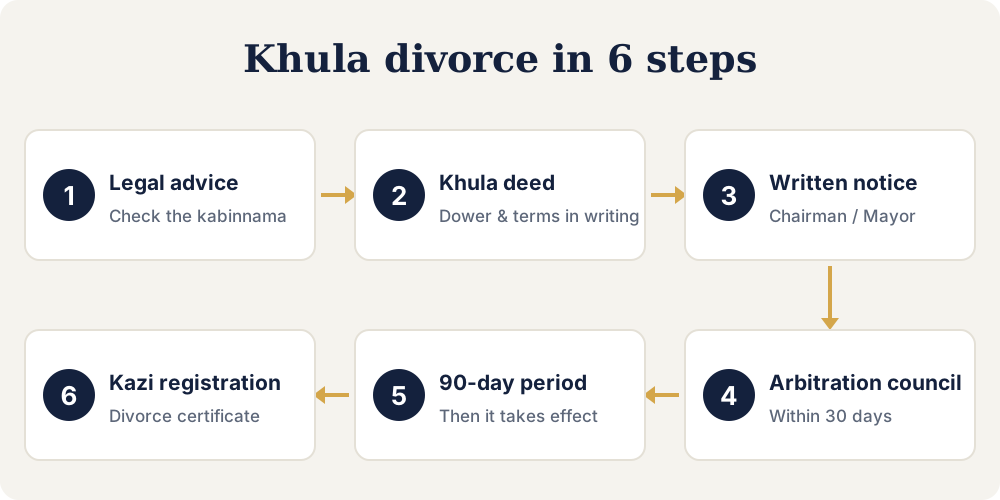
- Get legal advice. A lawyer first checks the kabinnama to confirm that khula is the right route — rather than tafweez or a Family Court suit.
- Agree the terms and sign a khula deed. How much den mohor is given up, iddat maintenance, custody and maintenance of the children, and return of jewellery and belongings are all written into the agreement (khulanama), which both spouses sign.
- Send written notice. Notice goes to the Chairman of the Union Parishad, or the Mayor of the City Corporation / Pourashava, for the area where the wife lives, with a copy to the other spouse.
- Arbitration Council. Within 30 days of receiving the notice, the Chairman or Mayor forms an Arbitration Council to attempt reconciliation. If there is no reconciliation, the process continues.
- Wait 90 days. The khula takes effect 90 days after the notice reaches the Chairman. If the wife is pregnant, it takes effect after 90 days or at the end of the pregnancy, whichever is later.
- Register with the Kazi. The divorce is registered with the Nikah Registrar (Kazi) and the divorce certificate collected. This certificate is needed for remarriage, passport, visa and NID corrections.
Documents needed
- Copy of the kabinnama / nikahnama
- National ID card (NID) or passport of both spouses
- The khula deed or settlement agreement signed by both parties
- Two passport-size photographs
- Birth registration certificates of any children
A wife’s rights in khula
Den mohor
The defining feature of khula is that the wife gives something up — usually den mohor. But how much is open to negotiation; there is no rule that the entire dower must be surrendered. Whatever is agreed must be written clearly so that there is no dispute later. Read more about den mohor and maintenance.
Iddat maintenance
After khula the wife observes iddat. Unless she expressly gives it up in the agreement, maintenance for this period is generally the husband’s responsibility.
Children
A mother may give up her own claims in khula, but child maintenance belongs to the child and cannot be waived. Custody is decided according to the welfare of the child. See child custody.
What if the husband refuses khula?
Khula needs the husband’s consent. If he refuses, the wife still has two options:
- Talaq-e-tafweez: if clause 18 of the kabinnama delegates the right of divorce, the wife can divorce on her own.
- A Family Court suit: under the Dissolution of Muslim Marriages Act, 1939, the wife can seek a decree on grounds such as failure to maintain her for two years, cruelty, the husband’s whereabouts being unknown for four years, or a second marriage without permission.
Both options are explained in divorce by wife.
Mistakes to avoid in khula
- Doing khula only verbally or on stamp paper. Without notice and registration, the marriage may still exist in law — a serious problem on remarriage.
- A vague agreement. Instead of “den mohor waived”, state exactly how much is given up and what remains payable.
- Leaving the children out of the agreement. If custody, visiting and monthly maintenance are not in writing, a court case may follow.
- Signing under pressure. Consent obtained by force is open to challenge. Take legal advice before you sign.
Every family’s situation is different. To know whether khula, tafweez or a court case is right for you, speak to an experienced lawyer with your kabinnama in hand. Living abroad? Khula can still be completed in Bangladesh — see divorce from abroad.
Need advice on khula?
Advocate Md. Maynuddin, Supreme Court of Bangladesh, assists confidentially with every stage — drafting the khula deed, serving notice, the Arbitration Council and registration.
Frequently asked questions
Does khula need the husband’s consent?
Yes. Khula is a divorce proposed by the wife and accepted by the husband. If he refuses and the kabinnama does not give the wife a delegated right of divorce (clause 18), she has to apply to the Family Court.
Does the wife get her den mohor in a khula divorce?
In khula the wife usually gives up all or part of her den mohor as part of the settlement. How much she gives up is decided in the written agreement; anything not given up remains payable.
How long does khula take to become effective?
It takes effect 90 days after the written notice reaches the Chairman or Mayor. If the wife is pregnant, it takes effect after 90 days or at the end of the pregnancy, whichever is later.
Can a mother give up child maintenance in khula?
No. Child maintenance is the child’s own right. A mother can give up her own den mohor in khula, but giving up child maintenance does not end the father’s duty to support the children.
Can the couple remarry after khula?
Yes. After the khula takes effect, the same couple can marry again through a fresh nikah with a new den mohor.
What is the difference between khula and talaq-e-tafweez?
In tafweez the wife divorces on her own using the delegated right in clause 18 of the kabinnama — the husband’s consent is not needed and the full den mohor stays payable. In khula the husband must agree, and the wife usually gives up den mohor or something else in return.